When you’re shopping for a new walk in cooler, the lowest price always gets your attention.
That’s because purchasing a new walk in is a major expense. And whether you’re replacing a failed unit, expanding storage for a growing foodservice operation, adding outdoor cold storage for a school cafeteria, or trying to control costs across multiple locations, spending less on your walk in fridge can seem like it leaves more room in your budget to spend on other things.
Except that your costs don’t end after your purchase. You still need to pay for electricity to run the unit, plus the parts and labor required to service and maintain it. And if your system performs poorly or goes down, you’ll add in additional costs in product loss, staff disruption, higher utility bills, and premature replacement.
That is why the cheapest walk in refrigerator is not always the lowest-cost walk in refrigerator.
A lower upfront sale price may still make sense in some situations, especially if you only need short-term storage or have a fixed budget. But if your business depends on cold storage every day, the better question isn’t what the walk in costs to buy. It’s what the walk in costs to own.
That question is even more important for multi-location operators. One inefficient or unreliable unit may be a manageable frustration at a single site. But when the same problem is repeated across several locations, even small differences in energy use, maintenance requirements, service calls, and replacement timing can add up. A walk in cooler decision goes beyond a one-time equipment purchase to become an operating cost that affects the entire organization.
Walk in cooler installation: The first hidden cost
When you’re comparing the price of one unit against the price of another, be sure to look closely at what’s included. One of the most important variables is whether the walk in arrives fully assembled and factory tested, or whether it requires on-site panel assembly, field refrigeration installation, and coordination among multiple contractors.
A metal panel walk in will usually arrive as a collection of parts that needs to be assembled on site. Electrical work will require an electrician, the refrigeration system may need to be installed in the field, and if the unit is going outdoors, there may also be additional requirements for drainage, weather protection, sealing, roofing, or site preparation. None of these installation costs are typically included in the original purchase price.
And that difference affects more than installation cost. It can also affect how many variables have to be managed before the unit is ready to perform and how well the unit will perform once assembled.
The quality of an on-site installation will depend on the experience of the contractors you hire and their attention to detail. The manufacturer’s intended performance depends on proper panel alignment, door fit, refrigeration sizing, drainage, and seam integrity. If those details are not handled correctly, the unit may leak air, allow moisture in, struggle to hold temperature, or require more frequent service.
As Dan Parsenow, regional sales manager with Polar King, explains, “One of the biggest mistakes buyers make is looking at the box costs up front without thinking through the additional costs to get it up and running… [and] if it’s put together poorly, it’s going to function poorly.”
Key takeaway:
When you’re comparing walk in cooler quotes, look beyond the sale price. Ask what’s included, who’s responsible for installation, whether the refrigeration system is factory installed and tested, and what needs to be done to get the unit ready to use. If a walk in doesn’t arrive fully assembled and factory tested, it can add to installation costs and introduce more variables that affect startup and long-term performance.
Not sure whether to choose indoor or outdoor refrigeration for your operation?
Check out Polar King’s guide: Outdoor vs. Indoor Walk in Coolers: What’s the Difference?
Commercial walk in cooler energy use: The cost that keeps coming back
Once your walk in cooler is up and running, the next hidden cost is energy.
A commercial walk in cooler or walk in freezer has to maintain a controlled interior temperature while the surrounding environment works against it. In a busy operation, the door may open frequently throughout the day, bringing in heat from the outside. In an outdoor application, that environment may also include humidity, rain, snow, wind, direct sun, or salt air.
That’s why walk in cooler energy efficiency isn’t just a sustainability issue. It’s an operating cost issue.
Lower-cost units may have weak insulation performance, thermal bridging, air leaks, moisture intrusion, or poorly sealed seams, making them use more energy to hold temperature. The compressor has to run longer and the components experience more wear. You’ll pay more for that cheaper construction month after month in higher utility bills.
FIELD TEST
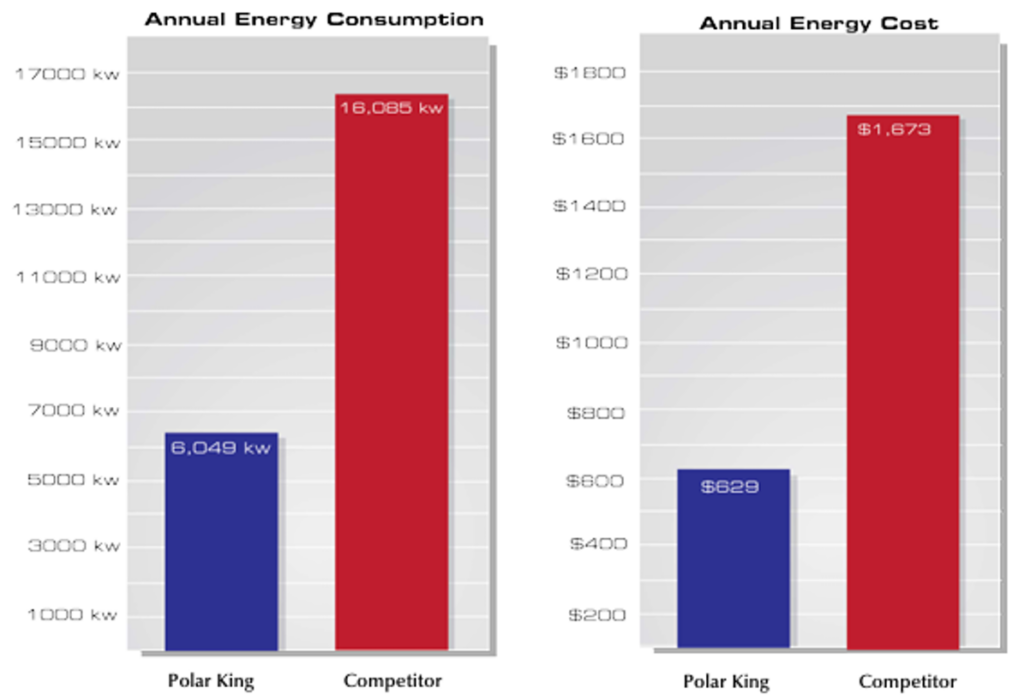
In a field comparison of two 8’ x 14’ outdoor walk in freezers that were over 10 years old, the Polar King unit used 349 kWh during the three-week test period, while the competitive unit used 928 kWh. Under the study’s stated cost assumptions, that difference represented $1,044 in estimated annual energy savings for the Polar King unit.
For a single location, that is meaningful. Across multiple restaurants, schools, convenience stores, or facilities, it can become a major total cost of ownership factor. A unit that costs an extra $800 per year in energy and maintenance expenses becomes $8,000 annually across ten locations even before adding in costs for downtime or premature replacements. The case for buying based on total cost of ownership, rather than purchase price, becomes even clearer at scale.
Whether that pressure comes from a franchisor, a district budget, a central purchasing team, or internal margin goals, the underlying issue is the same: small operating cost differences become much larger when they are multiplied across locations.
Key takeaway:
Before you buy a commercial walk in cooler, ask for estimated energy consumption. Then apply your local electric rate and compare the projected cost over the expected life of the unit, not just the first year.
Want to find out why construction affects operating cost? See our article on Superior Energy Efficiency in Walk in Coolers and Freezers.
Why walk in refrigeration construction affects R-value and operating cost
A walk in refrigerator depends on insulation to resist heat transfer, but the insulation needs to stay dry and protected to perform as intended. When moisture gets into the structure, the material’s ability to resist heat flow, measured in R-value, can decline. That means the unit becomes less efficient, and the refrigeration system has to work harder to maintain temperature.
This is one of the key differences between a seamless fiberglass walk in cooler and a traditional panel walk in cooler.
Panel walk ins are assembled from multiple sections with a seam where the panels connect. Every seam requires proper installation, proper sealing, and ongoing maintenance to help prevent air and moisture infiltration. Over time, those joints can expand, contract, separate, or allow air and moisture to enter.
At first, the symptoms may be easy to dismiss: some frost, a little condensation, slightly longer run times, or a door that doesn’t seal quite as well as it used to. But those early signs often point to a larger performance problem.
Parsenow describes the pattern this way: “Cheaper walk ins can start to show ice or frost buildup around the seams or doors. Then there are excessive refrigeration run times because the box isn’t holding temperatures. That leads to larger electric bills and is obviously harder on the equipment.”
That is where hidden costs compound. Moisture reduces insulation performance. Reduced insulation performance increases refrigeration run time. Longer run time increases energy use and equipment wear. Eventually, the walk in becomes more expensive to operate and less reliable.
This is especially important with outdoor walk in coolers and freezers. An outdoor unit has to withstand a wide range of challenging weather conditions over its lifetime. In coastal regions, salt air can accelerate rust and corrosion on metal surfaces. In humid climates, there’s a higher risk of moisture penetration. If a unit was designed primarily for indoor use and adapted for outdoor placement, you should find out how well it is protected from long-term exposure.
Key takeaway:
Ask manufacturers how their walk ins are constructed and protected against moisture.
Moisture penetration can reduce insulation performance, increase energy costs, contribute to ice or frost buildup, and shorten the useful life of the unit.
Moisture R-value study
A study performed by US Cooler Company in cooperation with Owens Corning and the US Corps of Engineers looked at how moisture affected the R-value of insulation. The best performing steel panel constructed walk in in the study lost 25% of its R-value over the course of five years due to moisture, while the average steel panel constructed walk in lost 75% of its R-value.
This study did not evaluate fiberglass walk ins, but manufacturer testing shows that Polar King units lose 0% of their R-value from moisture penetration over five years. This is because the rigid insulation is completely encapsulated in fiberglass, which prevents moisture from contacting the insulation.
Based on the study’s findings, a seamless walk in will provide 25% – 75% in energy savings over a metal panel walk in during the first five years. As an example, a 10’x12’x7’6” freezer operating at 32.5 degrees mean temperature with a refrigeration system with 90% efficiency and an electric cost of $.09/kWh would provide a savings of $2,560 – $7,709 during the first five years.
Walk in cooler maintenance has a cost even when nothing is broken
Walk in cooler maintenance requirements can vary greatly between manufacturers.
Unlike seamless fiberglass walk in coolers, panel walk ins often require periodic resealing to keep moisture out and maintain performance. This often means unloading the unit, warming the space, cleaning and drying the surfaces, completing the sealing work, bringing the unit back down to temperature, and reloading inventory.
This is a painstaking process, which is why maintenance often gets postponed. Even though staff members may know the unit should be resealed, they need the storage space. Service windows are limited, product has to stay cold, and deliveries have to be scheduled. The maintenance may be technically manageable, but it’s operationally inconvenient.
For a freezer, that process can be even more disruptive.
But if seam maintenance is skipped, the unit will be at greater risk of air infiltration, condensation, frost, ice buildup, reduced efficiency, service calls, and premature deterioration.
In contrast, a seamless fiberglass walk in structure eliminates joints and gaps that require regular maintenance, and its smooth surface makes cleanup fast and easy. This eliminates some of the biggest maintenance hassles associated with panel boxes.
Key takeaway:
When you compare walk in cooler options, ask what maintenance is required to preserve performance. Then ask whether that maintenance is realistic for your operation once the unit is full of product and in daily use.
Walk in cooler downtime can cost more than the repair
When a walk in cooler goes down, the repair invoice is the obvious consequence, but you also need to figure in the cost of downtime.
Refrigeration downtime can put thousands of dollars of food at risk in a restaurant cooler or freezer. It can disrupt meal service and force staff to move product between buildings in a school nutrition program. It can delay production in a food manufacturing operation. And it can threaten inventory that is difficult and expensive to replace for a pharmaceutical company.
And even when a product can be saved, it takes considerable time and effort. You may need to rent temporary refrigeration, transfer inventory, adjust production, call emergency service, or shuttle product to another facility. If breakdowns become frequent, those disruptions become part of the true cost of the unit.
Parsenow points out that downtime affects more than the equipment budget. In food and beverage operations, he says, “In worst case scenarios, you have to worry about food quality and protecting your business’s reputation.”
That is why reliability matters. In addition to the obvious monetary costs of an equipment failure, your inventory, time, and effort are all at risk.
That reliability starts with construction. When a walk in is built to resist moisture intrusion, reduce seam-maintenance needs, and support steady temperature performance, there are fewer opportunities for small issues to become costly interruptions.
Key takeaway:
When comparing products, consider the manufacturer’s warranty and reputation for reliability. The right walk in helps protect uptime, staff productivity, food quality, customer trust, and the continuity of your operation.
Walk in cooler service life changes the true cost
The cheapest walk in cooler can look attractive when you only compare purchase prices. But the math changes if the unit costs more to run, requires more maintenance, or breaks down more often. The other factor that affects true cost is how long it will last.
A lower-cost unit may make sense if you need a temporary solution or expect to use it for only a short period. But if you plan to operate in the same location for years, pass the business to the next generation, standardize equipment across multiple sites, or invest in permanent outdoor cold storage, how you invest your money today could affect your operations down the line.
If you manage multiple locations, service life also affects consistency. When every site has a different refrigeration setup, maintenance is harder to plan and compare. Staff may be managing different equipment, different service histories, different failure points, and different replacement timelines. Choosing a durable, repeatable walk in solution can make it easier to stock replacement parts, plan capital expenses, coordinate service, train staff, and keep operations more consistent from one location to the next.
How long will it hold temperature efficiently? Will the structure continue to resist moisture? Will the exterior withstand weather? Will the insulation continue to perform? Will the seams, roof, floor, door, and hardware remain reliable? Will you still be comfortable trusting it with high-value inventory years down the line?
In harsh environments, these questions become even more important. Coastal air, heavy humidity, outdoor exposure, frequent door openings, and heavy use can all shorten the life of a unit that wasn’t built for those conditions.
Parsenow notes that in coastal regions, cheaper metal panel boxes may deteriorate much faster than buyers expect because of rust and corrosion. “They might save 30 or 40% by buying a cheap metal panel box,” he says, “but they may need to replace it in only a few years because of the salt.”
That is the heart of the total cost question. Saving money upfront does not help if you are forced into major repairs, emergency rentals, higher utility bills, or early replacement.
Key takeaway:
Factor the expected lifespan into the equation in addition to the costs to operate, maintain, and repair the unit.
What you should look for when buying a commercial walk in cooler
Whether you’re investing in a restaurant walk in cooler, a school cafeteria unit, or outdoor cold storage for a multi-unit operation, a better walk in cooler purchase starts with informed questions. Instead of only comparing prices, consider which unit gives you the best long-term value for your application.
Start with installation. Is the unit delivered fully assembled, or does it require field assembly? Is the refrigeration system factory installed and tested, or will you need to coordinate installation after delivery? How many contractors will need to be involved before the unit is ready to use?
Then look at construction. Is the unit designed for outdoor use, or is it being adapted for outdoor placement? Does it have panel seams that require ongoing resealing? How is the insulation protected from moisture? Can the exterior rust, dent, or corrode? Is the interior easy to clean? Are there cracks, seams, or crevices where moisture and bacteria can collect?
Next, evaluate energy use. Ask the manufacturer for estimated energy consumption and compare it using your local electric rate. If you operate multiple locations, multiply that cost difference across every unit and every year of expected use.
Then review the warranty carefully. A long warranty may sound reassuring, but the details matter. Does it cover the structure? The floor? The roof? The door? The hardware? What happens if a panel fails? Is the buyer responsible for major labor or disassembly? How are refrigeration components covered?
If you operate multiple locations, you need to also think about repeatability. Can the same construction method, installation process, warranty structure, and maintenance expectations apply across current and future sites? The more consistent your refrigeration infrastructure is, the easier it becomes to manage costs, coordinate service, train teams, and plan replacements.
Key takeaway:
When choosing a commercial walk in cooler, compare installation cost, projected energy use, construction quality, maintenance requirements, warranty coverage, and expected service life before making a final decision.
Why Polar King walk in coolers are built for better long-term value
Polar King walk in coolers and walk in freezers are built from the ground up to address many of the problems that make cheaper units expensive over time.
Each unit is constructed with a seamless fiberglass interior and exterior bonded to rigid insulation. That one-piece design eliminates the panel seams found throughout traditional panel boxes. Without those seams, there are fewer places for moisture to enter, fewer joints to reseal, and fewer opportunities for air infiltration to compromise performance.
The fiberglass surface is smooth, continuous, and easy to clean. It resists rust and corrosion, which is especially important for outdoor walk in coolers, coastal locations, and humid environments. Fiberglass also doesn’t conduct heat the way metal does, helping reduce heat transfer and support more efficient operation.
Polar King units arrive pre-built and factory tested. Instead of coordinating panel assembly and field refrigeration installation, you receive a walk in designed to be set in place and connected to power. That can reduce installation complexity and help you get cold storage online with fewer variables.
The result is a walk in refrigeration system built to reduce the true cost of ownership through lower energy usage, minimal structural maintenance, fewer service calls, less downtime, and longer usable life. It’s not just a stronger box. It’s a better long-term investment.
The bottom line
A lower-cost unit may look attractive at the point of sale. But if it costs more to install, uses more energy, requires more maintenance, breaks down more often, or needs to be replaced sooner, the initial savings may not translate into better long-term value.
Quality walk in refrigeration protects inventory, helps control operating costs, and supports reliable performance over the life of the unit. The smart approach looks at the full economic picture from installation and energy spend to reliability and expected service life.
The goal is not to buy the least expensive walk in cooler you can find. It is to choose the unit that offers the best value for your business. A better long-term investment will continue to protect your inventory, control operating costs, and provide reliable performance for years to come.
Frequently Asked Questions (FAQs) about walk in cooler costs
What are the hidden costs of a cheap walk in cooler?
The hidden costs of a cheap walk in cooler can include installation labor, field refrigeration setup, higher energy use, more frequent service calls, added maintenance, product loss during downtime, and earlier replacement. The sale price may look attractive at first, but the true cost depends on what the unit costs to install, operate, maintain, and own over time.
How much does it cost to run a commercial walk in cooler?
The cost to run a commercial walk in cooler depends on the size of the unit, temperature setting, local electric rate, door openings, outdoor conditions, insulation performance, and overall construction. Before buying, ask the manufacturer for estimated energy consumption and calculate the projected operating cost using your local cost per kWh.
How long should a commercial walk in cooler last?
A high-quality commercial walk in cooler should provide many years of reliable service when it is properly sized, installed, maintained, and suited to its environment. Outdoor units, coastal locations, heavy use, and moisture exposure can shorten service life if the walk in is not built for those conditions.
What is a walk in cooler’s R-value, and why does it matter?
R-value measures how well insulation stops heat from passing through. In a walk in cooler, a higher-performing insulation system helps reduce heat transfer, which can lower refrigeration run time, improve temperature consistency, and reduce energy use. If moisture contacts the insulation, R-value can decline and the refrigeration system may have to work harder.
Is a seamless fiberglass walk in cooler more energy-efficient than a panel walk in cooler?
A seamless fiberglass walk in cooler is designed to be more energy-efficient because the insulation is encapsulated within a one-piece fiberglass structure, reducing the seams and gaps where air and moisture can enter. By helping protect insulation performance over time, seamless construction can reduce refrigeration run time and lower operating costs compared with traditional panel construction.
What is the difference between walk in cooler purchase price and total cost of ownership?
The purchase price is what you pay to buy the walk in cooler. Total cost of ownership includes the purchase price plus installation, energy use, maintenance, service calls, downtime risk, product loss, warranty coverage, and replacement timing. A lower upfront price does not always mean a lower long-term cost.
Get professional guidance from Polar King
Comparing walk in cooler options? The expert sales team at Polar King can help you look beyond the upfront price and evaluate the full cost of ownership for your operation. Reach out to us today.